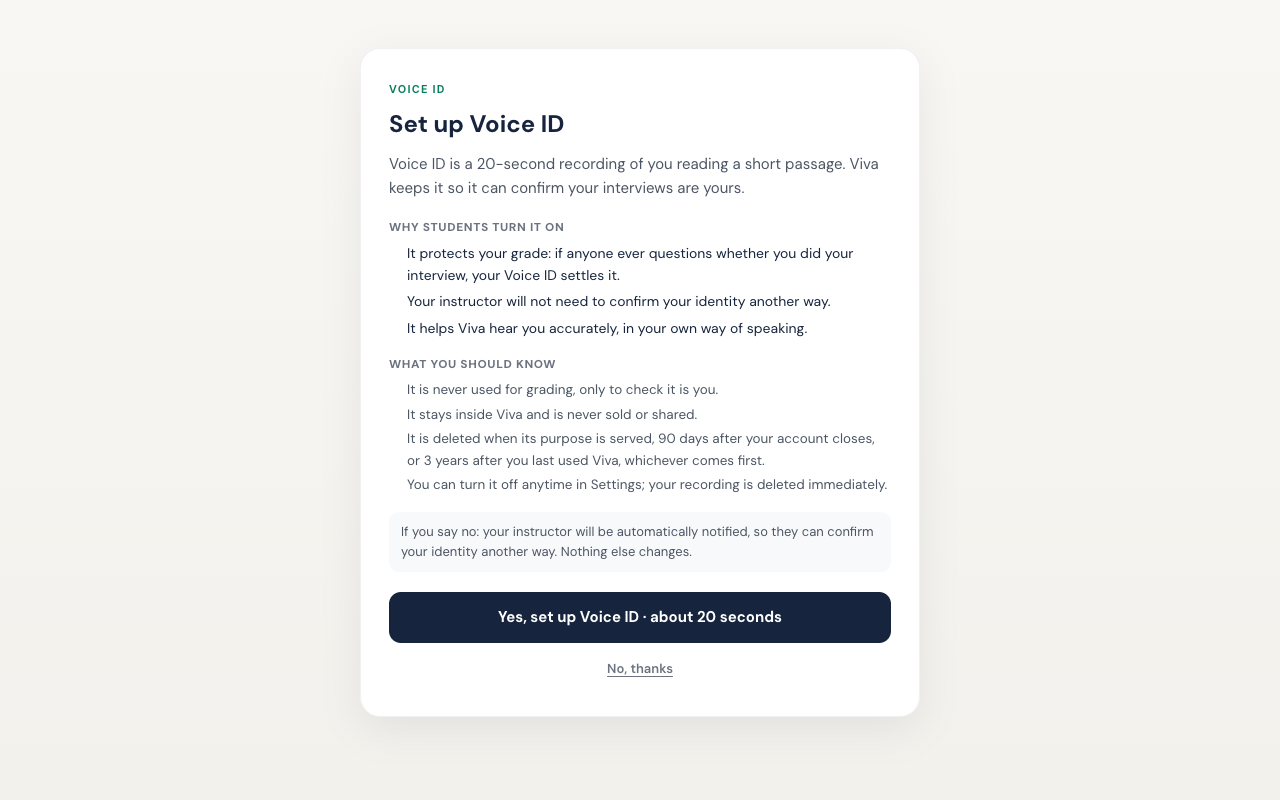
A short recording that lets Viva confirm later interviews are yours. Optional, and never used for grading.
231 reads
Voice ID is about a minute of you reading a short passage. Viva keeps that sample so it can check that the person in each later interview is you. You are asked on a screen of its own, which lists why it is kept, what is kept, for how long, that you can say no, and, if you are at a school, that your school is responsible for it and Viva handles it for them.
The whole choice is yours: set it up, or not now.
It is never used for grading. It only tells your instructor whether the voice matched.
It is never sold. It goes to two providers working only for Viva, Render, which computes the voiceprint and keeps nothing afterward, and Supabase, which stores it encrypted in Viva's database, and to nobody else.
It is deleted when its purpose is served, 90 days after your account closes or your school's contract ends (45 days in Colorado), or 1 year after you last used Viva, whichever comes first.
It protects your grade: if anyone ever questions whether you sat your own interview, the match settles it.
You see the screen right before an interview, not when you sign up. Choose Yes to set it up (you read the passage right there), or Not now. The first time you choose Not now, one short message says what happens without it. The screen comes back before a new assignment, at most once every 14 days, unless you tick Don't ask me again. Whatever you choose, your interview opens right after.
Saying no costs you nothing
If you choose Not now, your interview runs the same and your grade is not affected. Without Voice ID, your teacher may confirm it's you another way, for example by listening to your recording or a short in-person check. You are not treated as suspicious, and your teacher sees only whether Voice ID is on, never that you said no.
At a school, your class's grade decides
At a school (not a university), Voice ID is used only where your school has agreed to it in writing, and you never see this screen at any other school. Where it is used, it starts at 14 at the earliest, or later where the law sets a higher age for this consent: 14 in the US, Korea and China, 16 in the EU and most other countries, 18 in the UK and India. Your class's grade decides whether you are offered Voice ID, and you are never asked your age or your birth date. It is never offered in Grades 6 to 8; in the US and Korea, for example, it is offered from Grade 9. If any class you take at your school is a younger grade than that, it is not offered in any of your classes there. If a class of yours has a grade that does not show its youngest grade (for example none, "Mixed" or "IB / AP"), it is not offered until your instructor sets one that does. If you see the screen but are younger than the age it names, choose I'm not 14 yet (it shows your country's age) under the first paragraph and confirm: Voice ID is not used for you, you are not asked again, and nothing of yours is used for AI training. Either way your account works normally and your interviews run as usual. For now Voice ID is not offered at all to learners in the EU, the EEA or the UK, whether the school or the student is there. University students are never asked their age, except in Illinois: there Voice ID is only for university students 18 or older, and only after they sign Illinois's written biometric release on the Voice ID screen. It is never offered at Illinois K-12 schools.
You can change your mind either way
Said no and want it after all? Settings has a Set up Voice ID button any time, and the screen comes back before a new assignment, at most once every 14 days, unless you ticked Don't ask me again. Said yes and want it gone? Turn it off in Settings and the recording is deleted right away.