How does Viva generate its questions?
It reads the submission and your instructions, finds what is claimed, and builds questions that only the author could answer well.
The questions are built per student, from their own submission. Two students in the same class get different interviews because they wrote different things.
- It reads the submission, up to about 32,000 characters (roughly 5,000 words of English), including spreadsheet formulas, notebook outputs and text inside images.
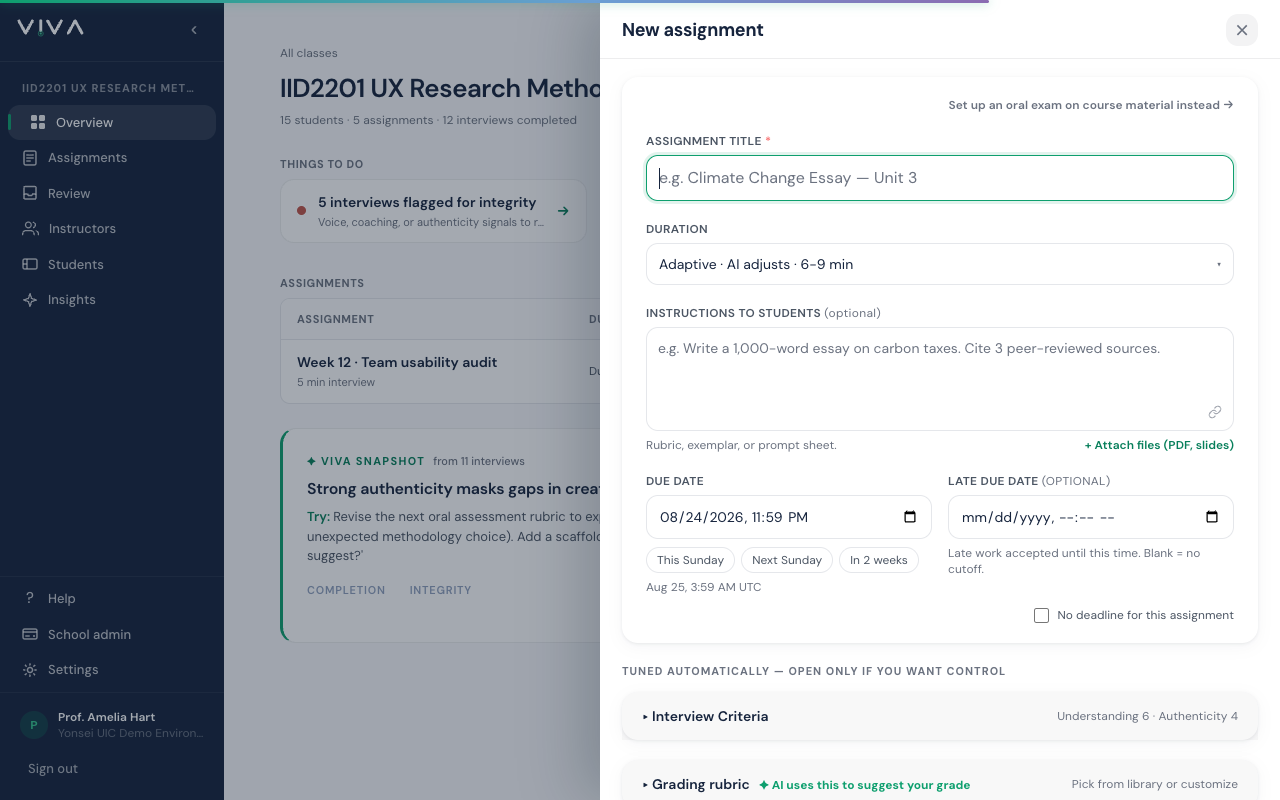
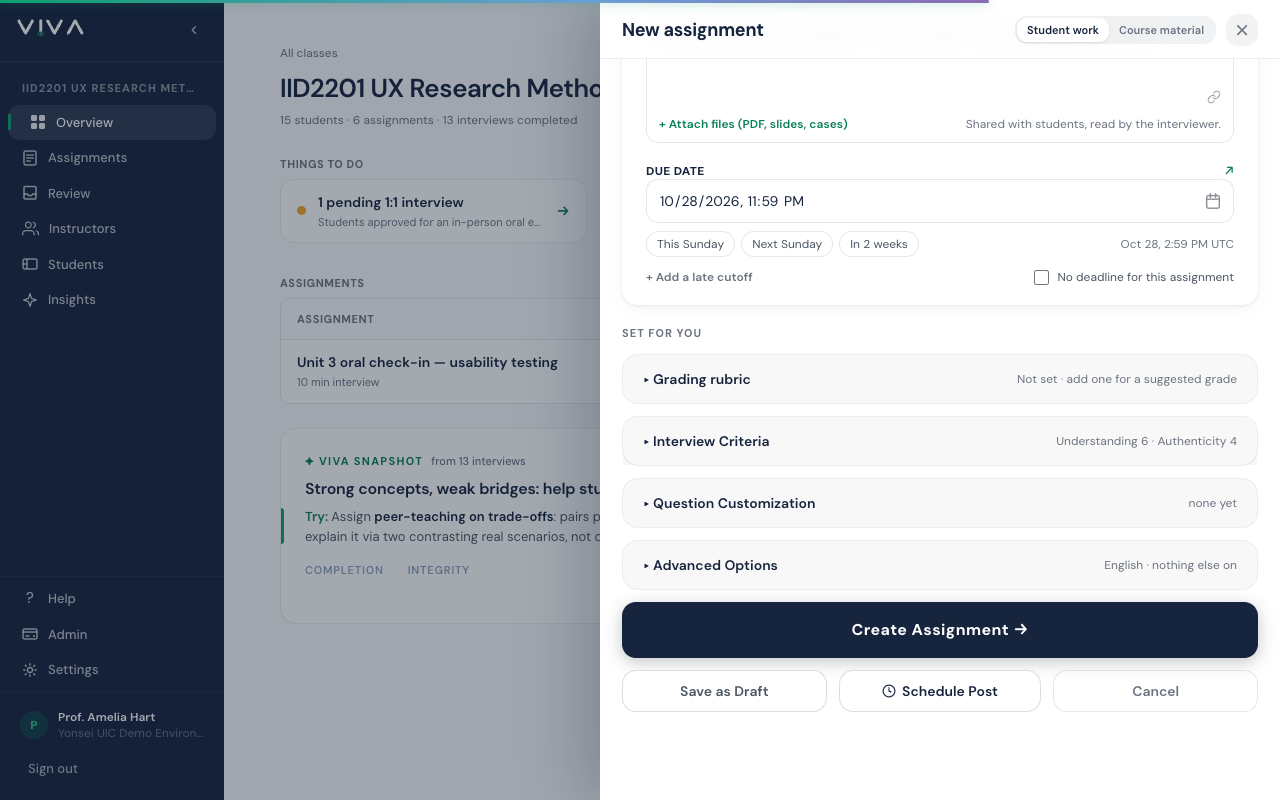
- It reads your instructions and reference files to learn what the task was meant to be.
- If you wrote Guidance for Viva, it tips which parts of the work get the most questions. Students never see that note.
- When the work has distinct parts, such as three policy recommendations, a problem set or several poems, it plans questions for each part and the interview takes them one at a time, in order, with a share of the time for each. Follow-ups still go as deep as the answers call for; Viva moves to the next part only after the student has finished answering, and time left at the end goes back to the part whose answers were weakest. With more parts than the interview can cover, such as twenty problems, it picks the ones that show the student's reasoning best and spreads them across the set.
- A problem set or a program gets its own kind of question, decided from the work itself: why this step and what it assumes, which way the answer moves if a number changed, the concept a step rests on, and how the student would know an answer is off. Each one names the problem and quotes the student's own line. Viva never asks for mental arithmetic, never has a number re-derived, and never asks what the problems mean for society or what the takeaway is.
- It picks the specific claims, choices and results in that student's work: the decisions an author would remember and a non-author would not.
- A source the student cites is material they used, not what they wrote. Viva asks how a source was used, why it was chosen or what it does for the argument, never what the source itself says or how it reached its result.
- It weights the set the way you set the weights, then adds your custom questions verbatim.
- During the conversation it follows up on what the student actually says, with the same text in front of it, so a follow-up can turn to any part of the work. That is the part a question list cannot fake.
What if a submission can't be read?
The interview won't start until questions exist for it. If a submission couldn't be read, the interview is held rather than run on nothing. If the AI that reads files declines to copy one word for word, which can happen with published text, Viva reads a description of that file instead. The description says so at the top, and Submission analysis leaves it out.
See also
Instructors get the rest: the walkthroughs, the screenshots, and Ask Viva, which finds the right page from a typed question.