Choosing an interview style
Keep the even-handed Examiner, or have Viva argue the other side, ask for first principles, or follow three dials you set. What each style does, when to use it, what students are told, and how grading treats it.
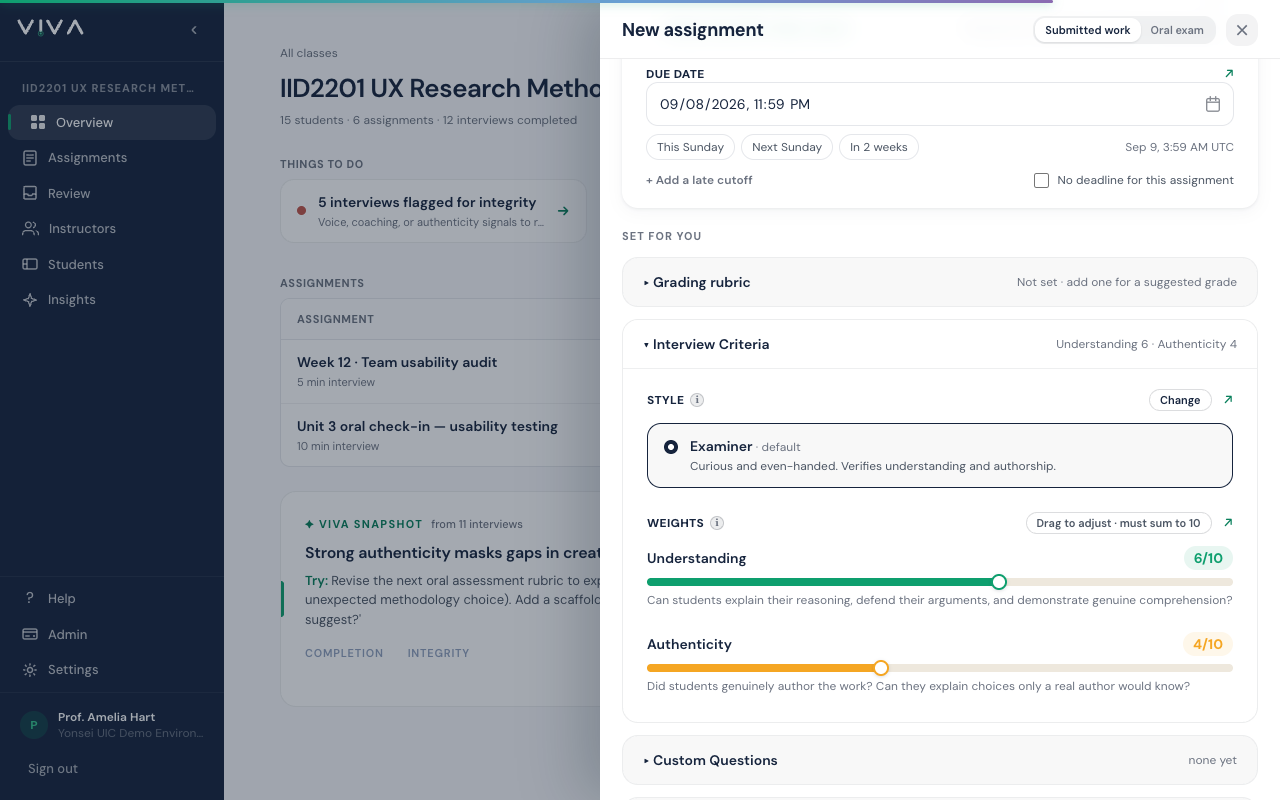
A style is how Viva probes, not a mood. The Examiner, the default, is curious and even-handed: it checks that the student understands their work and wrote it. The other styles change the method of questioning while keeping the same job, so an assignment never drifts away from the student's own work.
- 1
On the assignment form, open Interview Criteria. The style shows as one selected card under Style; click Change, or the card itself.
- 2
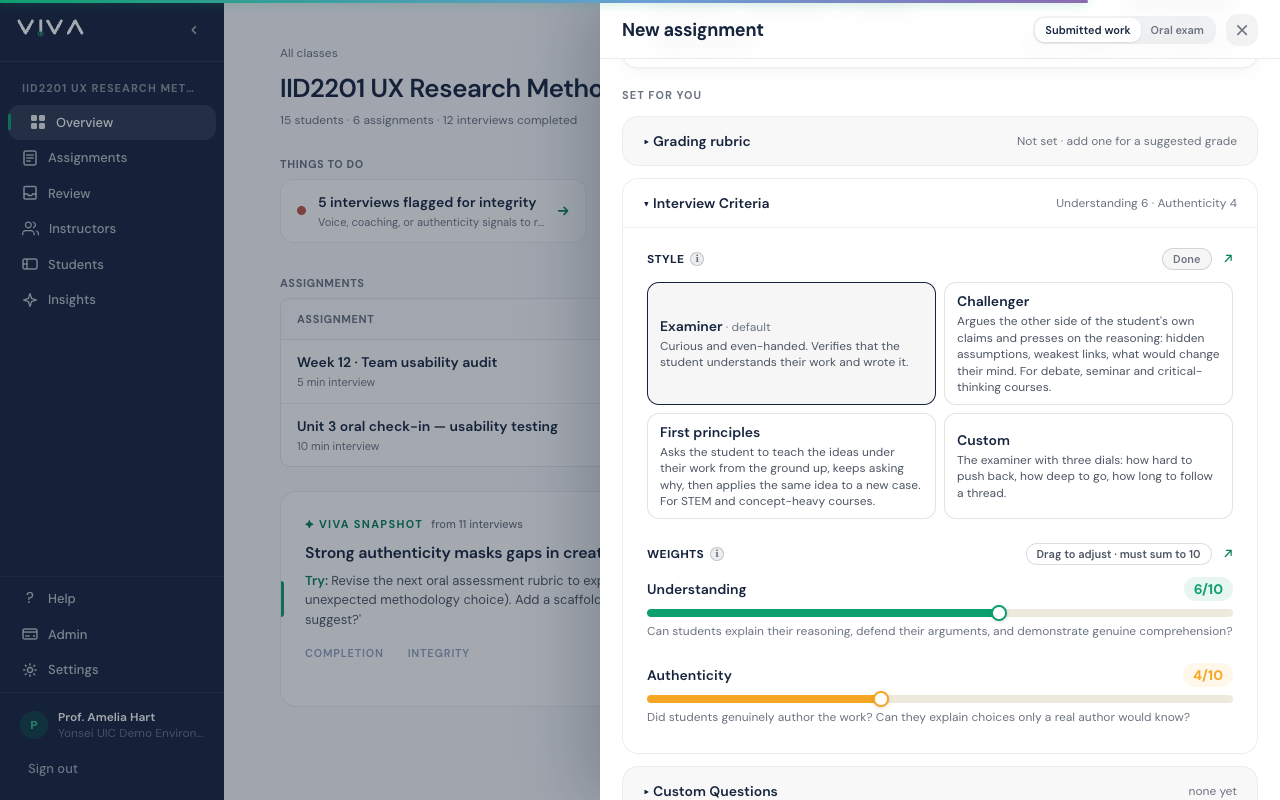
Pick a style. The line under the cards is what students see before they start.
Examiner
The interviewer Viva has always used. It asks about the work in front of it: what the student decided, why, what they would change, and the details only the author would know. Follow-ups are proportionate. Choose it for most assignments, and whenever the interview is primarily a check that the work was understood and done by the student.
Challenger
For argument and critical thinking. Once the student has explained a claim from their work, Viva takes the other side of that claim with the strongest specific counterargument and asks them to defend it, one counterargument at a time. It presses on the reasoning itself, naming the weakest link or a hidden assumption, and asks the student to shore it up. When a defense holds, Viva says so and asks for the strongest one-sentence version of the claim; when it does not, it asks what evidence would change their mind. It never invents facts and never argues for its own sake; defending a position is treated as a skill the student is exercising, not a trap.
Use it in seminar, debate, policy, philosophy and writing courses, and anywhere the quality of an argument is the point. Students are told before they start that Viva will push back and that being challenged is expected. Grading is told the same, so pushback is graded as pushback: a student who strengthens their argument under challenge, or concedes a weak point after a fair one, is credited for it.
First principles
For understanding beneath the work. Viva treats the student as the teacher and asks them to explain the ideas their work rests on from the ground up, as if to someone new to the topic. Every explanation gets a why: why does that step follow, what does it depend on, what would break it, can they give an example. It goes one layer deeper each time until it reaches something the student clearly owns or a gap, and names the gap kindly. Then it tests transfer: one small new case built from the same concept, with a condition or number changed, and asks what happens and why. Reasoning on a case the student has not rehearsed is what separates understanding from recall.
Use it in math, science, engineering, economics and any course where the reasoning under the work is the point. It differs from the Examiner in depth and direction: the Examiner stays with the work, First principles goes underneath it and then one step beyond it. Grading credits clear first-principles explanations and correct reasoning on the new case, and does not penalize a student for Viva pressing beyond what the assignment itself required.
Custom
The Examiner with three dials, each a fixed sentence: pushback (none, gentle or firm), depth (stay with the work, or go to the fundamentals) and follow-ups (short chains, or follow a thread deep). There is no free text, so nothing you type reaches the interviewer and the same setting always produces the same interviewer. The chosen dials show on the card so you can read them at a glance.
- Every style stays anchored to the student's own work and to your custom questions. A Challenger pushes only on claims that are actually in the work and never invents facts.
- Practice interviews use the same style, so students can prepare for it. Oral exams do not have styles yet.
- The panel header shows the style beside the weights, so you can check it without opening the panel.
Instructors get the rest: the walkthroughs, the screenshots, and Ask Viva, which finds the right page from a typed question.