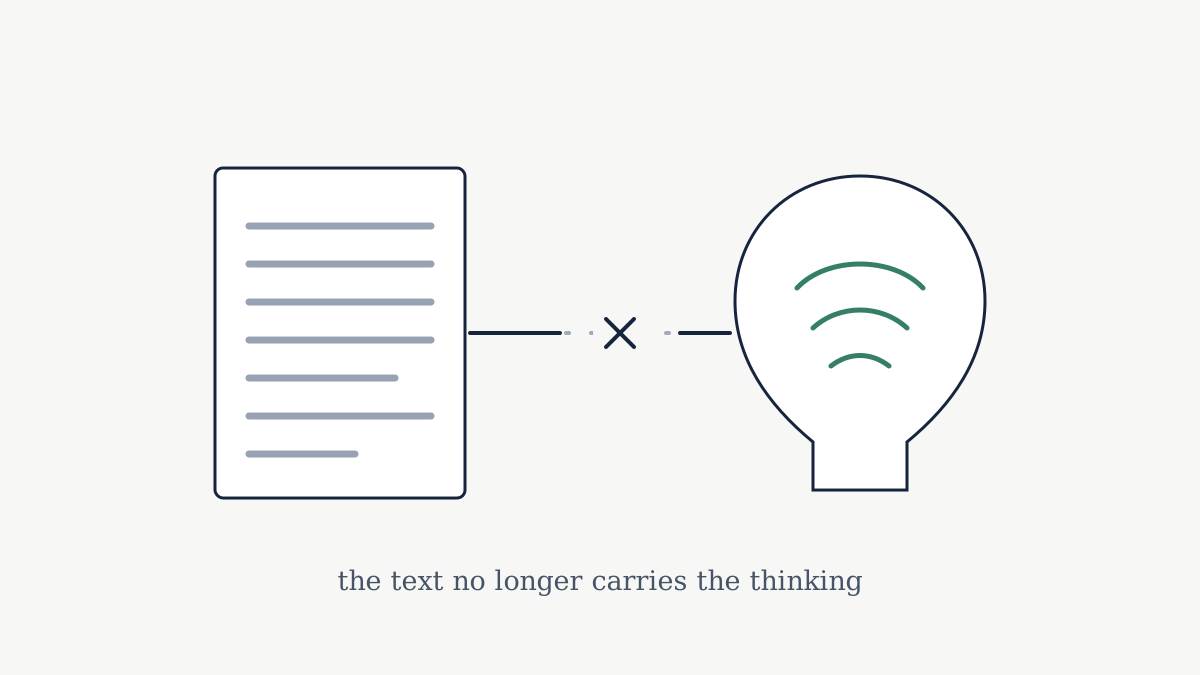
Here is a quiet assumption that held up most of modern education: if a student hands you a coherent essay, they must have done the thinking that produced it. The essay was never the point. It was a window. Instructors grade the text on the page, but what they are really grading is the mind they believe stands behind it.
The text still arrives on time. What broke is the inference from the text to the thinking.
That assumption survived plenty of abuse. Essay mills existed. So did helpful older siblings. But cheating used to cost money, take time, and leave a trail, so the window stayed mostly honest. Then large language models made fluent, original-looking prose available to any student, for any assignment, in seconds. The text still arrives on time. What broke is the inference from the text to the thinking.
This is worth saying carefully, because it is not a story about bad kids. The uncertainty hurts honest students just as much. When an instructor can no longer be confident that any given essay reflects its author's own reasoning, the grade means less for everyone, including the student who wrote every word at 1 a.m. with the door closed. Trust does not degrade selectively.
Early research is starting to put shape on the worry. In one widely discussed EEG study, participants who wrote with an AI assistant showed weaker engagement than those writing unaided, reported the lowest sense of ownership over their essays, and often could not accurately quote the work they had just produced. It is a preprint with a small sample, and it deserves the usual caution. But notice what it describes: a fluent artifact whose author cannot speak to its content. That is the exact failure the essay was supposed to make impossible.
The tempting response is prohibition. Ban the tools, punish the users. We think that is unstable, for two reasons. First, you cannot reliably enforce it at the level of a take-home artifact, which is the subject of our next post. Second, and more awkwardly, fluent use of AI is becoming a competence employers expect. A rule that can neither be enforced nor fully justified does not hold for long.
So the real question is not how to defend the essay. It is what evidence of learning should look like once the essay can no longer carry the weight alone. We think part of the answer is very old, and we will get to it soon. It involves asking the student to talk.
Next in this series: AI detection was never going to save the essay →